
Description
Imagine Having an Entire Year of Math Anchor Charts Done for You! Stop making anchor charts from scratch every single year. Grab standards-aligned, ready-to-print math posters and reference sheets for 3rd, 4th, or 5th grade in color, black & white, poster size, or notebook size. Print once, teach all year.
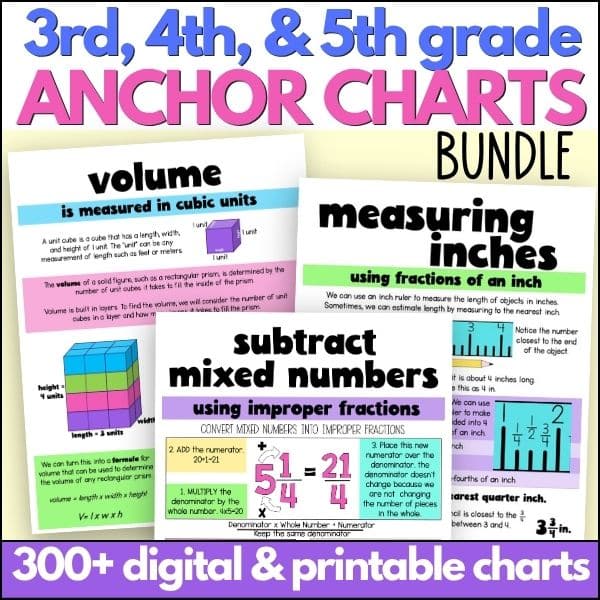
Get 3rd, 4th, AND 5th Grade Math Anchor Charts – All in One Bundle
This bundle includes all 308 anchor charts across 3rd, 4th, and 5th grade, covering every concept from place value through volume and coordinate planes, in every format: poster, standard, and notebook size, full color and black & white.
Perfect for:
- Classroom teachers who loop with students or teach a combined grade span
- Campus math coaches and interventionists who need reference materials spanning multiple grade levels on hand
- Math tutors working with students across 3rd–5th grade
Every Format You Could Need, In One Download
Each set includes:
- Full-color Google Slides (great for smartboards and virtual teaching)
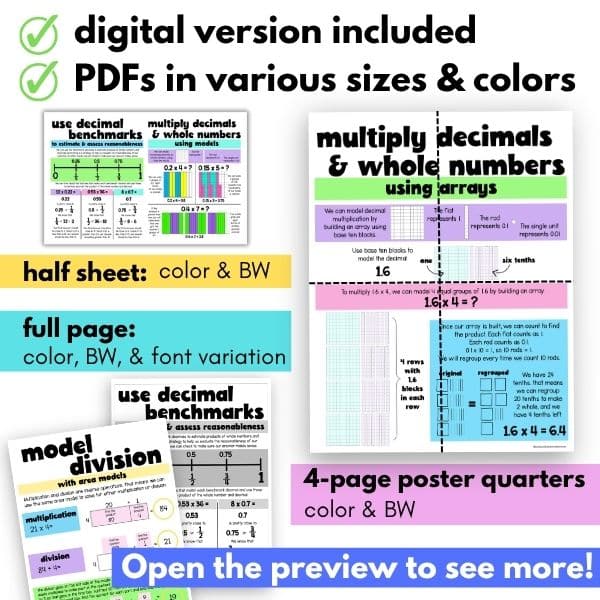
- Full-color 8.5×11 PDF posters
- Black & white 8.5×11 PDF (ink-saving option)
- Full-color and black & white 4×6 half-sheets (perfect for interactive notebooks)
- Full-color and black & white poster quarters (print and piece together into a 17×22 anchor chart)
- Bonus whimsical-font title versions for extra classroom charm
How to Use these Math Anchor Charts in Your Classroom
❤️ Whole group instruction — print poster-size and hang as true anchor charts
❤️ Math centers — print 8.5×11 and leave as quick reference sheets
❤️ Interactive notebooks — print half-sheets for students to glue in as notes
❤️ Word walls & bulletin boards — swap charts in as you move through units
❤️ Test review — flip through the Google Slides as a whole-class refresher before assessments
❤️ Binder reference — bind a full set into a book for independent “reading about math”
WHY TEACHERS KEEP COMING BACK
Across hundreds of verified ratings on TPT, teachers consistently point to the same three things: the charts are genuinely standards-aligned, they save serious prep time compared to making anchor charts by hand, and students return to them independently all year long — not just the week they’re introduced. Several teachers specifically mention printing a small version for student desks or notebooks in addition to the classroom-size posters, so kids always have the strategy in front of them.
Prep Doesn’t Get Any Easier Than This!
Forget hand-drawn anchor chart paper that never tears straight. Print once, file by unit, and you’re ready to teach every concept in seconds — all year long.
If you’re looking for the full breakdown of every math anchor chart included, this section is for you:
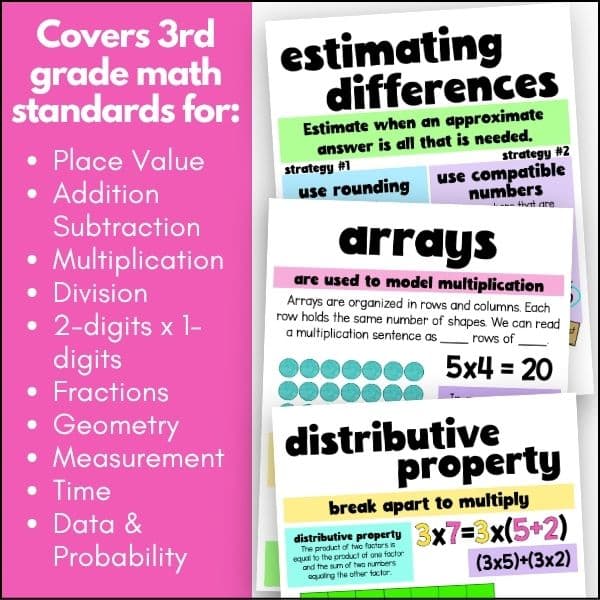
3rd Grade Math Anchor Charts for Place Value
- Using place value blocks and chips to model place value within 1000
- Writing numbers within 1000 in expanded form
- Writing numbers within 1000 in word form
- Comparing and ordering numbers within 1000
- Ways to show a number within 1000
- Using place value charts for numbers within 999,999
- Writing numbers within 999,999 in expanded form
- Comparing and ordering numbers within 999,999
- Rounding to the nearest 10 and 100
- Rounding to the nearest 1000 and 10,000
3rd Grade Math Anchor Charts for Addition
- Associative property of addition
- Commutative property of addition
- Identity property of addition
- Estimating sums for 3-digit numbers
- Using partial sums to add 3-digit numbers
- Three-digit addition with regrouping
- Adding more than two addends
3rd Grade Math Anchor Charts for Subtraction
- Estimating differences
- Borrowing to regroup and subtract 3-digit numbers
- Relating subtraction to addition
- Subtracting across zero
3rd Grade Math Anchor Charts for Multiplication within 100
- Representing multiplication with equal groups
- Understanding multiplication as repeated addition
- Relating multiplication to skip counting using number lines
- Representing multiplication with arrays
- Distributive property of multiplication
- Commutative property of multiplication
- Associative property of multiplication
- 0 as a factor
- 1 as a factor
- 2 as a factor
- 3 as a factor
- 4 as a factor
- 5 as a factor
- 6 as a factor
- 7 as a factor
- 8 as a factor
- 9 as a factor
- 10 as a factor
- Using multiplication tables
- Problem solving with multiplication
- Identifying key words for multiplication problem solving
- Writing multiplication stories/word problems
3rd Grade Math Anchor Charts for Division
- Understanding division as sharing
- Understanding division as repeated subtraction
- Multiplication and division fact families
- Division facts within 100
- Division involving 0 and 1.
- Key words for problem solving with division
- Problem solving with division
3rd Grade Math Anchor Charts for 2-Digit Multiplication
- Multiply multiples of 10 suing an open number line
- Multiply multiples of 10 using the associative property
- Multiply multiples of 10 using pattern rules
- Estimate products of 2-digits by 1-digit
- Using arrays to multiply 2-digits by 1-digit
- Using partial products to multiply 2-digits by 1-digit
- Using the distributive property to multiply 2-digits by 1-digit
- Using the place value algorithm to multiply 2-digits by 1-digit
3rd Grade Math Anchor Charts for Fractions
- Equal and unequal parts and representing parts of the whole
- Fractions as parts of a region
- Fractions as parts of a set
- Using fraction strips
- Using models to find equivalent fractions
- Using models to compare fractions with like denominators
- Using models to compare fractions with like numerators
- Using models to compare fractions with unlike numerators and denominators
3rd Grade Math Anchor Charts for Geometry
- Identifying triangles using sides vs. angles
- Definition and examples for:
- Point
- Line segment
- Ray
- Angle
- Right angle
- Acute angle
- Obtuse angle
- Intersecting lines
- Parallel lines
- Perpendicular lines
- Equilateral triangle
- Isosceles triangle
- Scalene triangle
- Acute triangle
- Obtuse triangle
- Right triangle
- Quadrilateral
- Parallelogram
- Rectangle
- Trapezoid
- Rhombus
- Square
- Congruent shapes
- Symmetrical shapes
3rd Grade Math Anchor Charts for Units of Measurement
- Measuring fractions of an inch
- Measurements of length
- Measurements of weight
- Measurements of capacity
- Metric measurements
- Telling time
- Describing time to the half hour, quarter hour, and fives
- Elapsed time working forward
- Elasped time working backward
- Finding area or regular shapes
- Finding area of irregular shapes
- Understanding perimeter
- Formulas for perimeter of regular shapes
3rd Grade Math Anchor Charts for Data and Probability
- Simple Probability
- Collecting Data with Frequency Tables
- Pictographs
- Bar Graphs
- Line Plots (aka Dot Plots)
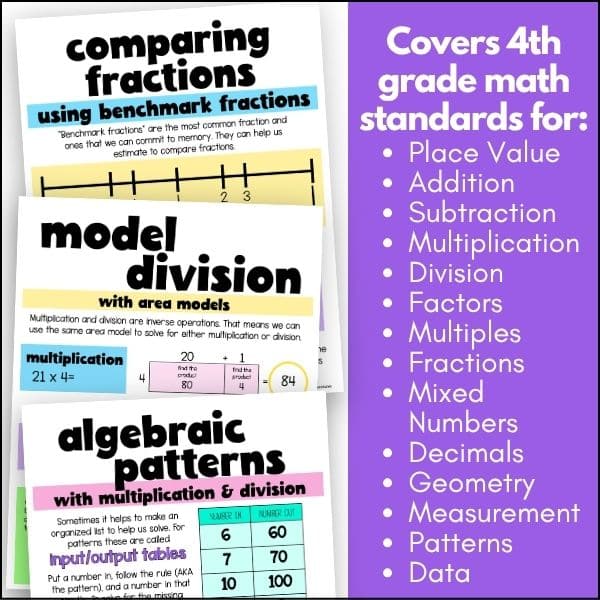
4th Grade Math Anchor Charts for Place Value
- Using place value charts through the millions place
- Writing numbers in expanded from through the millions place
- Comparing and order numbers through the hundred thousands place
- Rounding numbers to the thousand and ten thousand place
4th Grade Math Anchor Charts for Addition and Subtraction
- Estimating sums and differences
- Regrouping for addition
- Regrouping for subtraction
- Subtracting across zero
4th Grade Math Anchor Charts for Multiplication
- Multiplication of zero-digit numbers using the associative property
- Multiplication of zero-digit numbers using pattern rules
- Round factors to estimate products
- Using partial products with one 1-digit factor
- Using the distributive property with one 1-digit factor
- Using a place value algorithm with one 1-digit factor
- Mental math and multiplication
- Using area models with a multiple of 10
- Estimating products of 2-digit factors
- Using arrays for 2-digit factors
- Using partial products for 2-digit factors
- Using the distributive property for 2-digit factors
- Using the place value algorithm with a zero in the ones place
- Using the place value algorithm for 2-digit factors
- Steps for 2-digit multiplication
4th Grade Math Anchor Charts for Division
- Mental math and division
- Estimating quotients
- Interpreting remainders
- Using place value blocks for division
- Modeling division with area models
- Area models for 3- and 4-digit dividends
- Partial quotients
- DMSB division algorithm-divide, multiply, subtract, bring down
4th Grade Math Anchor Charts for Factors and Multiples
- Understanding factors
- Common factors
- Prime and composite numbers
- Common multiples
4th Grade Math Anchor Charts for Fractions and Mixed Numbers
- Area models for equivalent fractions
- Fraction strips for equivalent fractions
- Using multiplication for equivalent fractions
- Using common factors for equivalent fractions
- Area models for comparing fractions
- Comparing fractions with fraction strips
- Using benchmark fractions to compare fractions
- Using common denominators to compare fractions
- Adding fractions using number lines
- Adding fractions using computation
- Subtracting fractions using number lines
- Subtracting fractions using computation
- Adding mixed numbers by breaking apart
- Adding mixed numbers by using improper fractions
- Subtracting mixed numbers by borrowing/regrouping
- Subtracting mixed numbers using improper fractions
- Multiply fractions using fraction strips & number lines
- Multiply fractions using multiplication/division facts
- Multiply mixed numbers using the distributive property
- Multiply mixed numbers using improper fractions
4th Grade Math Anchor Charts for Decimals
- Relating decimals to fractions-tenths and hundredths
- Decimals on a number line-tenths and hundredths
- Decimals and place value-tenths and hundredths
- Adding tenths and hundredths as fractions and decimals
- Subtracting tenths and hundredths as fractions and decimals
- Decimals in money
4th Grade Math Anchor Charts for Geometry
- Classifying triangles by sides and angles
- Terms, definitions, and examples for
- Point, line, line segment, and ray
- Angle, right angle, acute angle, and obtuse angle
- Intersecting, parallel and perpendicular lines
- Equilateral, isosceles, and scalene triangles
- Acute, obtuse, and right triangles
- Quadrilaterals, parallelograms, rectangles
- Trapezoid, rhombus, and square
- Congruent shapes and symmetrical shapes
- Unit angles
- Measuring angles
- Complementary and supplementary angles
- Understanding area
- Area of irregular shapes
- Understanding perimeter
- Formulas for perimeter
4th Grade Math Anchor Charts for Units of Measurement
- Measurements of length
- Converting units of length
- Measurements of weight
- Converting units of weight
- Measurements of capacity
- Converting units of capacity
- Metric units and conversion
4th Grade Math Anchor Charts for Algebraic Patterns
- Number patterns with addition and subtraction
- Number patterns with multiplication and division
- Determine and write rules for number patterns
- Finding the nth shape in a repeating pattern
4th Grade Math Anchor Charts for Data and Probability
- Introduction to simple probability
- Collecting data and frequency charts
- Bar graphs
- Pictographs
- Line Plots
- Stem and Leaf Plots
- Line Graphs
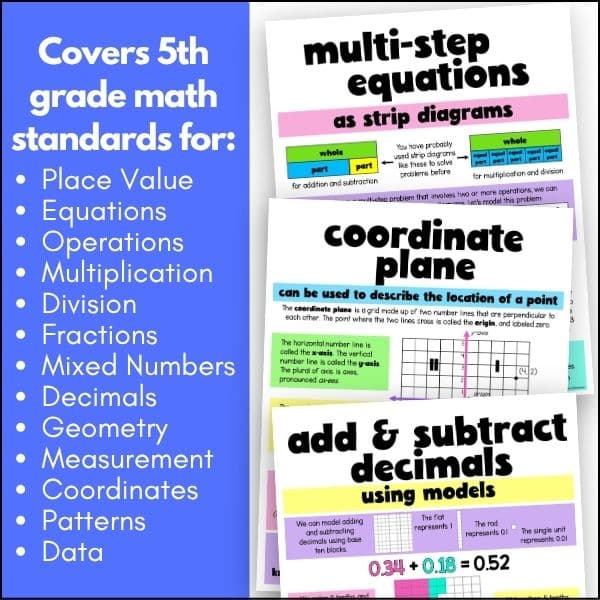
5th Grade Math Anchor Charts for Place Value with Decimals
- model decimals through the thousandths place
- ways to write decimals – standard, expanded form, and word form
- expanded notation
- powers of 10
- decimals on a number line
- rounding decimals
- compare and order decimals
- benchmark decimals
- decimals and money
5th Grade Math Anchor Charts for Expressions, Equations, & Order of Operations
- key words for operations
- model multi-step equations with strip diagrams
- numerical expressions, equations, and variables
- order of operations and grouping symbols
- prime and composite numbers
5th Grade Math Anchor Charts for Multi-Digit Multiplication of Whole Numbers
- mental math using powers of 10
- estimating products
- review the standard algorithm with 4-digits by 1-digit
- area model multiplication for 3-digits by 2 digits
- using the distributive property strategy with 2 digits and 3 digits
- using the partial products strategy for 3 digits by 2 digits
- using the standard algorithm for 3 digits by 2 digits
- standard algorithm quick-step guide
- extend the algorithm to 4-digits by 3-digits
5th Grade Math Anchor Charts for Long Division of Whole Numbers
- Mental math and division
- Estimating quotients using compatible numbers
- How to handle remainders
- Modeling division with area models
- Area models for 2-digt divisors
- Partial quotients with 1-digit divisor
- Two ways to represent partial quotients with 2-digit divisors
- Division algorithm with a 1-digit divisor
- Division algorithm with a 2-digit divisor
- Long division with zero in the quotient
5th Grade Math Anchor Charts for Adding & Subtracting Fractions with Unlike Denominators:
- add & subtract fractions with unlike denominators using fractions strips
- add & subtract fractions with unlike denominators using grid modelsmental math and benchmark fractions
- add and subtract fractions by using common multiples to find common denominators
- converting improper fractions to mixed numbers
- properties of addition applied to fractions
- adding mixed number by breaking them apart
- subtract mixed numbers by regrouping
- add and subtract mixed numbers by renaming them using improper fractions
5th Grade Math Anchor Charts for Multiplying and Dividing Fractions
- scale factor and scaling
- understanding fractions as division of whole numbers
- modeling multiplication as equal groups of fractional parts
- multiply by a fraction using fraction strips and number lines
- multiply by a fraction using math facts
- multiplying two fractions using models
- multiplying two fractions using math facts
- multiplying mixed numbers using models
- multiply whole number by mixed number using distributive property
- multiply two mixed numbers using the distributive property
- multiplication with mixed numbers using improper fractions
- dividing whole numbers by unit fractions using. models and equations
- dividing unit fractions by whole numbers using models and equations
5th Grade Math Anchor Charts for Adding and Subtracting Decimals
- Estimation strategies
- Add and subtract decimals using models
- Add and subtract decimals using place value
- Adding and subtracting money with friendly numbers
- Adding a fraction and a decimal
5th Grade Math Anchor Charts for Multiplying Decimals
- patterns for multiplying decimals by 10, 100, and 1000 and whole numbers by 0.1, 0.01, and 0.001
- estimating products with decimal benchmarks
- use base ten blocks to model multiplying decimals by whole numbers
- use arrays to model multiplying decimals by whole numbers
- using area models for multiplying decimals by whole numbers
- using the distributive property for multiplying decimals by whole numbers
- using partial products for multiplying decimals by whole numbers
- using the standard algorithm for multiplying decimals by whole numbers
- multiplying decimals less than one and zeros in the product
- using arrays for multiplying decimals by decimals
- using area models arrays for multiplying decimals by decimals
- using the distributive property arrays for multiplying decimals by decimals
- using partial products arrays for multiplying decimals by decimals
- using the standard algorithm arrays for multiplying decimals by decimals
5th Grade Math Anchor Charts for Dividing Decimals
- patterns for decimal division using powers of 10
- model decimal division using base 10 blocks
- model decimal division using area models using a full grid
- model decimal division using area models using a condensed grid
- dividing decimals using partial quotients
- dividing decimals by relating them to whole numbers and compatible numbers
- dividing decimals using the standard algorithm
- extending decimal dividends using zeros
5th Grade Math Anchor Charts for Geometry & 2-D Shapes
- Classifying triangles by sides and angles
- Classifying quadrilaterals
- Geometry terms, definitions, and examples for
- Congruent shapes and symmetrical shapes
- Point, line, line segment, and ray
- Angle, right angle, acute angle, and obtuse angle
- Intersecting, parallel and perpendicular lines
- Vertex, pentagon, hexagon, and heptagon
- Octagon, nonagon, decagon, and regular polygon
- Equilateral, isosceles, and scalene triangles
- Acute, obtuse, and right triangle
- Quadrilaterals, parallelograms, rectangles
- Trapezoid, rhombus, and square
5th Grade Math Anchor Charts for Area, Perimeter, and Volume
- Area of rectangles and composite shapes
- Perimeter and formulas for perimeter or regular polygons
- Cubic units, volume and formula for volume
- Volume of composite figures of rectangular prisms
5th Grade Math Anchor Charts for Measurement Conversions
- Converting units of length
- Converting units of weight
- Converting units of capacity
- Converting metric measurements
- Units of time and finding elapsed time
- Working backward in time using a number line
5th Grade Math Anchor Charts for Coordinate Planes and Patterns
- Understanding the coordinate plane
- Graphing ordered pairs on the grid in quadrant I
- Graphing additive and multiplicative patterns
- Analyzing patterns and looking for relationships
5th Grade Math Anchor Charts for Data Analysis and Graphs
- data collection using frequency tables
- representing categorical data on bar graphs
- graphing with line plots (a.k.a. dot plots) – CCSS terminology
- graphing dot plots (a.k.a. line plots) – TEKS terminology
- analyzing trends in data on line graphs
- using stem and leaf plots
- graphing data on scatterplots
Check out the preview for a taste of the 3rd, 4th, and 5th grade anchor charts included!
______________________________________________________________
Copyright ©Curious Classroom Adventures
Permission granted to copy for single classroom use only.
Sharing is kind! Please purchase additional licenses if you intend to share this product.

Reviews
There are no reviews yet.