
Do you have a tough time teaching equivalent fractions? You’re definitely not alone. Fractions can be one of the trickiest topics to teach—and to learn! If your students get that glazed-over look as soon as you bring up numerators and denominators, don’t panic. I’ve got your back.
Let’s talk about sseven super effective (and fun!) strategies that will make teaching equivalent fractions a whole lot easier—for you and your students.

1. Use a Multiplication Chart or Skip Counting Sticks
One of the simplest ways to help students see how equivalent fractions work is to use a multiplication chart. For example, line up the 3s row and the 5s row. When you look across, you’ll see a whole line of fractions that are equivalent to 3/5—like 6/10, 9/15, and 12/20. 💡 Lightbulb moment!
Don’t want to haul out a full chart? Try skip counting sticks for a hands-on way to practice equivalent fractions. They’re a great tool for math centers or small group work.

2. Break Out the Area Models
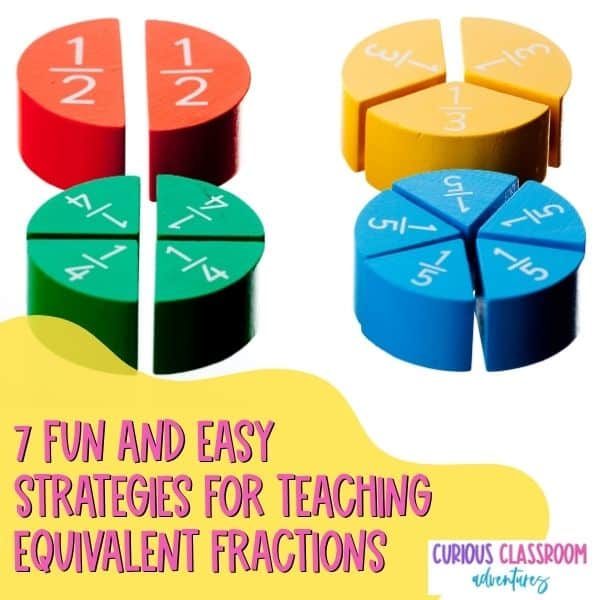
If you’ve been teaching equivalent fractions without area models and fraction circles, you’re missing out on one of the clearest visual tools around.
Area models show how fractions represent equal parts of the same whole. When students can see that 1/2, 2/4, and 4/8 all shade the same portion of a rectangle, it really clicks. Plus, they double as a springboard for understanding fractions on a number line later on.

3. Fraction Strips for the Win
Fraction strips are another classroom MVP when it comes to teaching equivalent fractions. They’re like mini number lines made for comparing fractions.
Lay out a 1/2 strip, then place a 2/4 and 4/8 strip next to it—and boom! Students can clearly see that all three are the same length. This makes abstract ideas feel concrete, especially for visual learners.
👉 Grab a free printable set of fraction strips here!

4. Play Equivalent Fraction Games
Games are magic in the classroom. They build engagement, foster collaboration, and make learning feel like play.
Try a game like Equivalent Fraction Bump. Players match up pairs of equivalent fractions and “bump” their opponents off the board. It’s a fast-paced, strategic way to reinforce what they’ve learned—and they’ll ask to play it again and again.
(And let’s be honest—it’s way more fun than a worksheet.)
5. Get Moving with a Fraction Scavenger Hunt
Reviewing equivalent fractions doesn’t have to mean sitting still! Try a scavenger hunt where students find and match up fraction cards hidden around the classroom.
Each card has a fraction, and their job is to find its equivalent pair. The best part is that you can use different models, pictures, and representations of each fraction so students get practice building a deep understanding of equivalent fractions. It’s a great way to combine math practice with movement—and a sneaky way to burn off some energy, too.

6. Measure with a Ruler or Tape
Real-world math for the win! Rulers and measuring tapes are awesome tools for teaching equivalent fractions in a way that feels practical and relatable.
Have students measure out 1/2 inch, 2/4 inch, and 4/8 inch. When they realize those marks land in the exact same spot? ✨ Mind. Blown. ✨
It’s a powerful way to connect fractions to something they can physically see and touch. It also sets the stage for your units on measurement conversions, fractions on a number line, and line plot graphs that involve fractions.

7. Use Pattern Blocks to Build Equivalent Fractions
Pattern blocks aren’t just for geometry! They’re an awesome hands-on tool for teaching equivalent fractions, too. Try this: assign the yellow hexagon a value of 1 whole. Then have students build that same shape using other blocks—like using 2 red trapezoids (each worth 1/2), or 6 green triangles (each worth 1/6). It’s such a satisfying “aha!” moment when they physically build different combinations that represent the same whole. Plus, it sneaks in some critical thinking and spatial reasoning while you’re at it!
Make Teaching Equivalent Fractions Even Easier
Ready to take things up a notch? You don’t have to plan it all yourself! I’ve created a done-for-you Equivalent Fractions Unit packed with:
-
Easy-to-follow mini-lessons
-
Interactive notebook pages
-
Partner games and cooperative activities
-
Practice worksheets that actually make sense to kids
It’s everything you need to feel confident teaching equivalent fractions—all in one place.
👉 Click here to check out the Equivalent Fractions Unit!

Bonus Tip: If you’re teaching equivalent fractions around the holidays, check out this adorable Christmas lights bulletin board idea. Each light bulb shows a different fraction pair—and your hallway will look just as brilliant as your students’ math thinking!
Get 4 Free Resources Every Month!
You read that right! I’ll share an easy-to-use and engaging upper elementary resource straight to your inbox every week along with a fabulous classroom idea or two to make teaching a little less work and a lot more fun!
Here’s the first freebie to get you started!

CLICK HERE TO GRAB YOUR FIRST FREE RESOURCE TODAY!
I’ve got more great ideas for fractions in these blog posts:
How to Teach Fractions to 3rd Graders: 6 Fun and Effective Strategies
The Versatility of Fraction Strips: A Must-Have Math Manipulative
Two Strategies to Teach Adding Mixed Numbers: A How-To Guide for Upper Elementary Math Teachers
One Response